
Wednesday, October 29, 2008

Bartlby the Weapons Supplier and Strategist
“Bartleby, the Scrivener” by Herman Melville is an interesting story that draws the reader to the character of Bartleby. The reader knows that he exists but does not have any background information as to where he came from, who he is, and why is he here. Throughout the story Bartleby is depicted as a quiet, willful character, which is most evident through his actions. As an example, he never says “yes” to any task that the lawyer asks him to do, but when asked, he does it in a polite fashion without any true hostile attitude. As readers, we are at the edge of our seat wondering if any of these requested tasks will ever break the fellow, hooking us and drawing us more to this interesting character.
Melville simply introduces Bartleby as the character who works in this job with the lawyer. We know nothing of Bartleby’s existence prior to that point. His demeanor and actions, however, provide the reader with some insight and much imagination as to who Bartleby is, how he looks, and the story behind this person. This brings us to his probable “Facebook” description.
If Bartleby had his picture in “Facebook”, it would probably be something unexpected. The picture of his profile would be of him with a ginger-nut in place of a cigar and he would be with Osama Bin Ladin and his terrorist regime. During his day job he is known as a scrivener, but Bartleby would describe himself as the man to know for the latest weapons and strategies for taking over the world. Weaponry and military strategy development would be described as his true passions and purpose in life, which is ignited further with the underworld clientele that he meets and serves. Because of this, most of his business transactions occur online. He demands payment in ginger-nuts and in incredible amounts of money (Only American Dollars and Euro’s).
Only a handful of people, who live by night and in the underworld, know of Bartleby’s weapons and strategies. This handful is enough to fund his covert and extravagant lifestyle, living in the fast lane to nowhere with everyone he encounters--outside of his day job. He attends the biggest parties with A-list celebrities, showing off his exotic vehicles with diamond studded rims. He plans parties online and has conversations with people whom he would never speak with during the day. Sometimes he forgets himself and miraculously, maybe robotically, brings himself back to the office and the lawyer.
That is why one day the lawyer found Bartleby sleeping in the office. Bartleby couldn’t remember where he lived so he crashed at the office. One can only imagine the horridness of the strategies that he plots with his friends. So horrid, that he forgets himself. No surprise, as his friends are Al Pacino whom he appreciates as Scarface. That persona taught him how to play hard ball with the big boys. Among the list of friends would be George Bush, whom he plays golf with on a regular basis, and whom he credits as the mentor who taught him how to deal with his inner fears of failure. Dr. Phil would also be on his friends list because before Bartleby took the scrivener position he was involved in supplying weapons and strategic plans to somebody who almost blew up the world; that person’s name was Donald Trump.
He feels extremely disappointed with his “other” life so he seeks and needs direction. It was Dr. Phil who told him to just start simple and to not forget his strength. So Bartleby took the job so he could just be simple during the day and not worry about his real job. He decided to just do what he wanted to do, and he would go politely about it because Al Pacino taught him that. Online, however, Bartleby is a force to be reckoned with--never giving in to a person’s wishes, only his. He vows to conceal his true identity by being as quiet and mysterious as possible during the day.
Bartleby’s backlist of his statuses of this week would be: Monday- Bartleby is in need of daily direction with life. Tuesday- Bartleby prefers not to do anything at this moment. Wednesday- Bartleby is thinking if you mess with the bull, you get the horns. Thursday- Bartleby is blah. Friday- Bartleby is meeting some clients at the jail house, and then going to eat some food.
This is why Bartleby-by-day is so intriguing. We can imagine that his true persona is very different from what is described at the office. We get a sense that he uses his day life to give him some cover as juxtaposition to his real job at night online. It is a cover-up for him in case people become suspicious of his quiet persona. They will never figure out his true identity—unless they looked him up on “Facebook”.
Melville simply introduces Bartleby as the character who works in this job with the lawyer. We know nothing of Bartleby’s existence prior to that point. His demeanor and actions, however, provide the reader with some insight and much imagination as to who Bartleby is, how he looks, and the story behind this person. This brings us to his probable “Facebook” description.
If Bartleby had his picture in “Facebook”, it would probably be something unexpected. The picture of his profile would be of him with a ginger-nut in place of a cigar and he would be with Osama Bin Ladin and his terrorist regime. During his day job he is known as a scrivener, but Bartleby would describe himself as the man to know for the latest weapons and strategies for taking over the world. Weaponry and military strategy development would be described as his true passions and purpose in life, which is ignited further with the underworld clientele that he meets and serves. Because of this, most of his business transactions occur online. He demands payment in ginger-nuts and in incredible amounts of money (Only American Dollars and Euro’s).
Only a handful of people, who live by night and in the underworld, know of Bartleby’s weapons and strategies. This handful is enough to fund his covert and extravagant lifestyle, living in the fast lane to nowhere with everyone he encounters--outside of his day job. He attends the biggest parties with A-list celebrities, showing off his exotic vehicles with diamond studded rims. He plans parties online and has conversations with people whom he would never speak with during the day. Sometimes he forgets himself and miraculously, maybe robotically, brings himself back to the office and the lawyer.
That is why one day the lawyer found Bartleby sleeping in the office. Bartleby couldn’t remember where he lived so he crashed at the office. One can only imagine the horridness of the strategies that he plots with his friends. So horrid, that he forgets himself. No surprise, as his friends are Al Pacino whom he appreciates as Scarface. That persona taught him how to play hard ball with the big boys. Among the list of friends would be George Bush, whom he plays golf with on a regular basis, and whom he credits as the mentor who taught him how to deal with his inner fears of failure. Dr. Phil would also be on his friends list because before Bartleby took the scrivener position he was involved in supplying weapons and strategic plans to somebody who almost blew up the world; that person’s name was Donald Trump.
He feels extremely disappointed with his “other” life so he seeks and needs direction. It was Dr. Phil who told him to just start simple and to not forget his strength. So Bartleby took the job so he could just be simple during the day and not worry about his real job. He decided to just do what he wanted to do, and he would go politely about it because Al Pacino taught him that. Online, however, Bartleby is a force to be reckoned with--never giving in to a person’s wishes, only his. He vows to conceal his true identity by being as quiet and mysterious as possible during the day.
Bartleby’s backlist of his statuses of this week would be: Monday- Bartleby is in need of daily direction with life. Tuesday- Bartleby prefers not to do anything at this moment. Wednesday- Bartleby is thinking if you mess with the bull, you get the horns. Thursday- Bartleby is blah. Friday- Bartleby is meeting some clients at the jail house, and then going to eat some food.
This is why Bartleby-by-day is so intriguing. We can imagine that his true persona is very different from what is described at the office. We get a sense that he uses his day life to give him some cover as juxtaposition to his real job at night online. It is a cover-up for him in case people become suspicious of his quiet persona. They will never figure out his true identity—unless they looked him up on “Facebook”.
Sunday, October 19, 2008
Revised Paper
“In a Station of the Metro”, Pound reminds us that life can be one rapid blur of events or it can be as distinct and lingering as the memory and beauty of a single petal of a flower. I am reminded of this belief through the patrons who frequent my aunt and uncle’s café/flower shop in the town of Patterson. Many of their customers are people who are in their upper forties and lower fifties of age. Every time we have talks about life they always tell me that life is short and that it flies by, much like trains on a metro. In just two lines this poem presents the reader with imagery, symbolism, and a deep meaning of life.
The reader can infer from line one when Pound says “these faces”, he is implying that he is there observing and watching the people at the station. Through his eyes and the first line of the poem vivid imagery is created; it describes faces of people waiting at the transit station. The important factor of this line is the word “apparition”; this word is usually attached to a person or character that has passed away or been murdered. By using a word that denotes a singular noun, signifies that Pound sees no differentiation in all the faces that he sees, but rather that he sees them as one, ghostly blurred image. Perhaps through his eyes, he sees no one who stood out to make a distinct and visible difference in this world.
The selection of the word “apparition” also incites the feeling and connotation that the faces have souls that are unfulfilled and searching for answers, much like ghosts. As an observer who sees this apparition, there is also a perceived sense of panic as these collective faces watch the selection of metro trains going here and there. Which train will lead them to their chosen destination and fulfillment in life; will it just pass them by and will they be one minute too late?
All of these images and invoked feelings are important to the poem because they seamlessly relate to the second line, “Petals on a wet, black bough”. This adds to the ominous yet true meaning of the poem which describes how all the people at the station are bound to pass through their own, personal timeline of life. Everybody there at the station has their short and limited existence on this earth. That is why Pound describes them as “apparitions” because he knows that people will come and go as long as the earth keeps revolving. The second line also paints a picture in the reader’s mind of petals on a black branch of a tree. The petals’ lives are imminently to the end, as the branch that sustains them to life is black and is dying, just as we have to fall to death at some point in our lives.
Another important factor that makes “In a Station of the Metro” a tightly, well-woven piece of literature, is the irony of its shortness and simplicity. The briefness of the two lines makes a powerful statement; there is parallelism between the shortness of life and the shortness of the poem. Life is short, and yet it does not have to be overly done with so much movement and noise like trains in a metro. Pound brings that parallelism to life and provokes emotion through imagery and perhaps even sound. Imagine the metro full of trains, representative of life destinations. One can hear roaring and pounding activity, representative of everything and everyone around our lives. The apparition is the fading blur of the individuals who let life go by without making a difference…and the reality is that their train is coming to a screeching halt. At times, as humans, with so much activity, we choose to make life complex and often times, meaningless with the decisions that we make or fail to make. Pound contrasts this complex, meaningless, reality through the simplicity of the petals.
The deliberate point of making the simple petals so distinguishable, and then, making the human form, blurred and undistinguishable, sends a message of its own. Pound could have used “dried leaves”; however, he chose petals. When one reads the word “petals”, a picture of flowers, with such beauty, so distinct as to be recognized by its individual petals, is visualized. Perhaps even tender, warm, and loving memories are created by such petals coming to mind. These petals are leaving this earth in a very simple, yet, sharp and distinguishable manner, unlike the complex and confused individuals blurred into one undistinguishable blob.
All this is found in this two-line poem. While it may be too late for the faces in the apparition, the writer is perhaps reaching out to us, its readers with a ticket—a ticket and an opportunity to reflect on our own lives and our own destinations. Sure life is short, however, it is long enough to make a difference, to affect those around us, even if only for a brief moment.
What will I do with my ticket? Well, I’m going back to my aunt and uncle’s café/flower shop, to join in on the laughter and to soak in and truly appreciate the lingering smell of freshly ground coffee. Most importantly, I’ll be taking the time to put my life in slow motion, blocking it from the distractions of meaningless noise and movement. While I’m there, I’ll also purchase my favorite flower as a reminder to myself to make a distinct and lingering difference with each passing day. Yes, life is short, and at times, complex with its many destinations, like the trains in the metro. However, life is also like a single petal, with the simple ability to create lasting, meaningful, and distinguishable memories. Which train and petal will you choose to be?
Pound, Ezra. “In a Station of the Metro”. The Norton Introduction to Literature. Ed. Peter Simpson. New York: W.W. Norton & Company, 2005.
The reader can infer from line one when Pound says “these faces”, he is implying that he is there observing and watching the people at the station. Through his eyes and the first line of the poem vivid imagery is created; it describes faces of people waiting at the transit station. The important factor of this line is the word “apparition”; this word is usually attached to a person or character that has passed away or been murdered. By using a word that denotes a singular noun, signifies that Pound sees no differentiation in all the faces that he sees, but rather that he sees them as one, ghostly blurred image. Perhaps through his eyes, he sees no one who stood out to make a distinct and visible difference in this world.
The selection of the word “apparition” also incites the feeling and connotation that the faces have souls that are unfulfilled and searching for answers, much like ghosts. As an observer who sees this apparition, there is also a perceived sense of panic as these collective faces watch the selection of metro trains going here and there. Which train will lead them to their chosen destination and fulfillment in life; will it just pass them by and will they be one minute too late?
All of these images and invoked feelings are important to the poem because they seamlessly relate to the second line, “Petals on a wet, black bough”. This adds to the ominous yet true meaning of the poem which describes how all the people at the station are bound to pass through their own, personal timeline of life. Everybody there at the station has their short and limited existence on this earth. That is why Pound describes them as “apparitions” because he knows that people will come and go as long as the earth keeps revolving. The second line also paints a picture in the reader’s mind of petals on a black branch of a tree. The petals’ lives are imminently to the end, as the branch that sustains them to life is black and is dying, just as we have to fall to death at some point in our lives.
Another important factor that makes “In a Station of the Metro” a tightly, well-woven piece of literature, is the irony of its shortness and simplicity. The briefness of the two lines makes a powerful statement; there is parallelism between the shortness of life and the shortness of the poem. Life is short, and yet it does not have to be overly done with so much movement and noise like trains in a metro. Pound brings that parallelism to life and provokes emotion through imagery and perhaps even sound. Imagine the metro full of trains, representative of life destinations. One can hear roaring and pounding activity, representative of everything and everyone around our lives. The apparition is the fading blur of the individuals who let life go by without making a difference…and the reality is that their train is coming to a screeching halt. At times, as humans, with so much activity, we choose to make life complex and often times, meaningless with the decisions that we make or fail to make. Pound contrasts this complex, meaningless, reality through the simplicity of the petals.
The deliberate point of making the simple petals so distinguishable, and then, making the human form, blurred and undistinguishable, sends a message of its own. Pound could have used “dried leaves”; however, he chose petals. When one reads the word “petals”, a picture of flowers, with such beauty, so distinct as to be recognized by its individual petals, is visualized. Perhaps even tender, warm, and loving memories are created by such petals coming to mind. These petals are leaving this earth in a very simple, yet, sharp and distinguishable manner, unlike the complex and confused individuals blurred into one undistinguishable blob.
All this is found in this two-line poem. While it may be too late for the faces in the apparition, the writer is perhaps reaching out to us, its readers with a ticket—a ticket and an opportunity to reflect on our own lives and our own destinations. Sure life is short, however, it is long enough to make a difference, to affect those around us, even if only for a brief moment.
What will I do with my ticket? Well, I’m going back to my aunt and uncle’s café/flower shop, to join in on the laughter and to soak in and truly appreciate the lingering smell of freshly ground coffee. Most importantly, I’ll be taking the time to put my life in slow motion, blocking it from the distractions of meaningless noise and movement. While I’m there, I’ll also purchase my favorite flower as a reminder to myself to make a distinct and lingering difference with each passing day. Yes, life is short, and at times, complex with its many destinations, like the trains in the metro. However, life is also like a single petal, with the simple ability to create lasting, meaningful, and distinguishable memories. Which train and petal will you choose to be?
Pound, Ezra. “In a Station of the Metro”. The Norton Introduction to Literature. Ed. Peter Simpson. New York: W.W. Norton & Company, 2005.
Tuesday, October 14, 2008
Big Essay
Victtor Lopez
Life is almost as short as Ezra Pound’s poem “In a station of the Metro”. I am reminded of this belief through the patrons who frequent my uncle café in the town of Patterson, which is in the central valley. Many of his customers are people who are in their upper forties and lower fifties of age. Every time we have talks or discussions about life they always tell me that life is short and that it flies by, much like trains at a metro whizzing by as people wait for it to stop. In just two lines this poem presents the reader with imagery, symbolism, and a deep meaning of life.
The reader can infer from line one when Pound says “these faces”, he is implying that he is there observing and watching the people at the station. Through his eyes and the first line of the poem vivid imagery is created; it describes faces of people waiting at the transit station. The important factor of this line is the word “apparition”; this word is usually attached to a person or character that has passed away or been murdered. By using a word that denotes a singular noun, signifies that Pound sees no differentiation in all the faces that he sees, but rather that he sees them as one, ghostly blurred image. Maybe he is describing the people who didn’t standout of the crowd and make something happen of them-selves. Perhaps through his eyes, he sees no one who stood out to make a distinct and visible difference in this world.
The selection of the word “apparition” also incites the feeling and connotation that the faces have souls that are unfulfilled and searching for answers, much like ghosts. As an observer who sees this apparition, there is also a perceived sense of panic as these collective faces watch the selection of metro trains going here and there. Which train will lead them to their chosen destination and fulfillment in life; will it just pass them by and will they be one minute too late?
All of these images and invoked feelings are important to the poem because they seamlessly relate to the second line, “Petals on a wet, black bough”. This adds to the ominous yet true meaning of the poem which describes how all the people at the station are bound to pass through their own, personal timeline of life. Everybody there at the station has their short and limited existence on this earth. That is why Pound describes them as “apparitions” because he knows that people will come and go as long as the earth keeps revolving. This is an interesting point because he is at station which is where trains come and go on their timeline as well, they come on an expected time just as humans do, and leave at an expected time as some humans do. The second line also paints a picture in the reader’s mind of petals on a black branch of a tree. The petals’ lives are imminently to the end, as their branch that sustains them to life is black and is dying, just as we have to fall to death at some point in our lives. I have never seen death portrayed in such an environment as the metro. Pound brilliantly chose this location perhaps to lead the reader to think about the shortness of life and how it flies by before one knows that it has, and to draw parallelism between the trains and the people who both have a timed schedule to meet.
Another important factor that makes “In a Station of the Metro” a tightly, well-woven piece of literature, is the irony of its shortness. The briefness of the two lines makes a powerful statement that eludes tour limited presence on this earth. Pound creates parallelism between the shortness of life and the shortness of the poem by the fact that the poem is only two lines but there is more than meets the eye to it. Furthermore, he brings that parallelism to life and provokes emotion through imagery and perhaps even sound. The metro must be full of trains, representative of life destinations because no two lives or people are the same. However, the metro is also full of roaring and pounding noise, representative of everything and everyone around our lives. The apparition is the fading blur of the individuals who let life go by without making a difference…and the reality is that their train is coming to a screeching halt. Although Pounds poem is only a simple poem with not very images in the poem. It evokes more than what is written on the pages of our books. This poem is very compelling and very delightful to read.
All this delighfulness is found in this two-line poem. While it may be too late for the faces in the apparition, the writer is perhaps reaching out to us, its lets readers have an opportunity to reflect about our own lives and our own destinations. Will we allow life to pass us by? Will we just be a face in the crowd blending in? Will I be the café’s patron complaining and commenting that life is too short, or will I be making a difference in this world and for the individuals around me? I hope my ticket takes me to the latter destination.
Pound, Ezra. “In a Station of the Metro”. The Norton Introduction to Literature. Ed. Peter Simpson. New York: W.W. Norton & Company, 2005.
Life is almost as short as Ezra Pound’s poem “In a station of the Metro”. I am reminded of this belief through the patrons who frequent my uncle café in the town of Patterson, which is in the central valley. Many of his customers are people who are in their upper forties and lower fifties of age. Every time we have talks or discussions about life they always tell me that life is short and that it flies by, much like trains at a metro whizzing by as people wait for it to stop. In just two lines this poem presents the reader with imagery, symbolism, and a deep meaning of life.
The reader can infer from line one when Pound says “these faces”, he is implying that he is there observing and watching the people at the station. Through his eyes and the first line of the poem vivid imagery is created; it describes faces of people waiting at the transit station. The important factor of this line is the word “apparition”; this word is usually attached to a person or character that has passed away or been murdered. By using a word that denotes a singular noun, signifies that Pound sees no differentiation in all the faces that he sees, but rather that he sees them as one, ghostly blurred image. Maybe he is describing the people who didn’t standout of the crowd and make something happen of them-selves. Perhaps through his eyes, he sees no one who stood out to make a distinct and visible difference in this world.
The selection of the word “apparition” also incites the feeling and connotation that the faces have souls that are unfulfilled and searching for answers, much like ghosts. As an observer who sees this apparition, there is also a perceived sense of panic as these collective faces watch the selection of metro trains going here and there. Which train will lead them to their chosen destination and fulfillment in life; will it just pass them by and will they be one minute too late?
All of these images and invoked feelings are important to the poem because they seamlessly relate to the second line, “Petals on a wet, black bough”. This adds to the ominous yet true meaning of the poem which describes how all the people at the station are bound to pass through their own, personal timeline of life. Everybody there at the station has their short and limited existence on this earth. That is why Pound describes them as “apparitions” because he knows that people will come and go as long as the earth keeps revolving. This is an interesting point because he is at station which is where trains come and go on their timeline as well, they come on an expected time just as humans do, and leave at an expected time as some humans do. The second line also paints a picture in the reader’s mind of petals on a black branch of a tree. The petals’ lives are imminently to the end, as their branch that sustains them to life is black and is dying, just as we have to fall to death at some point in our lives. I have never seen death portrayed in such an environment as the metro. Pound brilliantly chose this location perhaps to lead the reader to think about the shortness of life and how it flies by before one knows that it has, and to draw parallelism between the trains and the people who both have a timed schedule to meet.
Another important factor that makes “In a Station of the Metro” a tightly, well-woven piece of literature, is the irony of its shortness. The briefness of the two lines makes a powerful statement that eludes tour limited presence on this earth. Pound creates parallelism between the shortness of life and the shortness of the poem by the fact that the poem is only two lines but there is more than meets the eye to it. Furthermore, he brings that parallelism to life and provokes emotion through imagery and perhaps even sound. The metro must be full of trains, representative of life destinations because no two lives or people are the same. However, the metro is also full of roaring and pounding noise, representative of everything and everyone around our lives. The apparition is the fading blur of the individuals who let life go by without making a difference…and the reality is that their train is coming to a screeching halt. Although Pounds poem is only a simple poem with not very images in the poem. It evokes more than what is written on the pages of our books. This poem is very compelling and very delightful to read.
All this delighfulness is found in this two-line poem. While it may be too late for the faces in the apparition, the writer is perhaps reaching out to us, its lets readers have an opportunity to reflect about our own lives and our own destinations. Will we allow life to pass us by? Will we just be a face in the crowd blending in? Will I be the café’s patron complaining and commenting that life is too short, or will I be making a difference in this world and for the individuals around me? I hope my ticket takes me to the latter destination.
Pound, Ezra. “In a Station of the Metro”. The Norton Introduction to Literature. Ed. Peter Simpson. New York: W.W. Norton & Company, 2005.
Sunday, October 5, 2008
In a Station at the Metro-Ezra Pound


Life is almost as short as Ezra Pound’s poem “In a station of the Metro”. My uncle owns a café in the town of Patterson; many of his customers are people who are in their upper forties and lower fifties of age. Every time we have talks about life they always tell me that life is short and that it flies by. “In a Station of the Metro” is a poem because it presents the reader with imagery, symbolism, and a deep meaning of life in just two lines. The reader can infer from line one when Pound says “these faces”, he is implying that he is there observing and watching the people at the station.
The first line of the poem has vivid imagery; it describes faces of people waiting at the transit station. The important factor of this line is the word “apparition”, this word is usually attached to a person or character that has passed away or was murdered. This is important to the poem because it relates to the second line, “Petals on a wet, black bough”, this adds to the ominous yet true meaning of the poem which describes how all the people at the station are bound to pass through their own personal timeline of life; everybody there at the station has their short and limited existence on this earth. That is why Pound describes them as “apparitions” because he knows that people will come and go as long as the earth keeps revolving. The second line also paints a picture in the reader’s mind of petals on a black branch of a tree. The petals have to fall off sometime as the tree is black and is dying, just as we have to fall to death at some point in our lives. Another important factor that makes “In a Station of the Metro” a poem is the shortness of it; the two lines make a powerful statement of the shortness of life which is directly related to the shortness of the poem.
The first line of the poem has vivid imagery; it describes faces of people waiting at the transit station. The important factor of this line is the word “apparition”, this word is usually attached to a person or character that has passed away or was murdered. This is important to the poem because it relates to the second line, “Petals on a wet, black bough”, this adds to the ominous yet true meaning of the poem which describes how all the people at the station are bound to pass through their own personal timeline of life; everybody there at the station has their short and limited existence on this earth. That is why Pound describes them as “apparitions” because he knows that people will come and go as long as the earth keeps revolving. The second line also paints a picture in the reader’s mind of petals on a black branch of a tree. The petals have to fall off sometime as the tree is black and is dying, just as we have to fall to death at some point in our lives. Another important factor that makes “In a Station of the Metro” a poem is the shortness of it; the two lines make a powerful statement of the shortness of life which is directly related to the shortness of the poem.
“In a station of the Metro” is a work of poetry because of the deep meaning of the content, the shortness of life, how death takes us away, and the imagery used to convey these ideas. Pound had a great understanding of the nature of the universe and he creatively converyed it through this short, two lined, piece of poetry.
Pound, Ezra. “In a Station of the Metro”. The Norton Introduction to Literature. Ed. Peter Simpson. New York: W.W. Norton & Company, 2005.
Wednesday, October 1, 2008
Casabianca by Hemans
Victtor Lopez
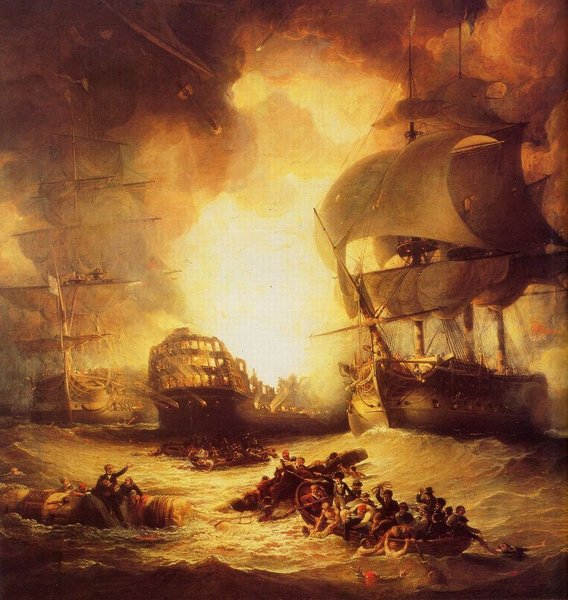
Casabianca is a powerful tale of a boy’s loyalty, obedience, and courage to stay upon a burning ship’s deck as the flames surround him while tearing down the ships structure. The images that are most prominent in this poem are that of the boy standing on the ship’s deck while the flames creep closer and surround him. The images of the boy on the deck reoccur throughout the entire poem subtly changing. In the beginning the poem creates a scene of the flames starting around the edges the ship, all the while the boy standing on the deck displaying his loyalty to his father. As the poem progresses the boy shouts to his father asking him for orders, and each time he asked in the poem the flames "roll'd on" and "made way" which evokes the image of the fire closing in on the boy’s location. In line 30 the flames caught the ships flag on fire, which showed the reader that the flames had spread to all areas of the ship. Although the boy stayed in the same spot throughout the poem the images that were described of him changed as well.
Casabianca is a powerful tale of a boy’s loyalty, obedience, and courage to stay upon a burning ship’s deck as the flames surround him while tearing down the ships structure. The images that are most prominent in this poem are that of the boy standing on the ship’s deck while the flames creep closer and surround him. The images of the boy on the deck reoccur throughout the entire poem subtly changing. In the beginning the poem creates a scene of the flames starting around the edges the ship, all the while the boy standing on the deck displaying his loyalty to his father. As the poem progresses the boy shouts to his father asking him for orders, and each time he asked in the poem the flames "roll'd on" and "made way" which evokes the image of the fire closing in on the boy’s location. In line 30 the flames caught the ships flag on fire, which showed the reader that the flames had spread to all areas of the ship. Although the boy stayed in the same spot throughout the poem the images that were described of him changed as well.
In the beginning he was just a boy who stood on the deck waiting for his orders from his father, by the second stanza he was a “proud, childlike form”, this paints a picture in the reader’s mind of person who is more than meets the eye. Although he is in a child’s body he has more inside of him than those crew members who fled the ship. In line 31 he is described as a “gallant child”, loyal to his father and the ship, and by line 40 he is “young faithful heart”. The young faithful heart further proves that the boy was courageous and faithful to his father’s word. The images of the boy are more prominent than of the flames. The boy was the main figure of all the images he was the center, the flames surrounded him. It seemed like the flames were a backdrop for the boy, who was the central figure of the poem. This poem presented the reader with plenty of picturesque scenes that displayed the boy’s strength and desire to obey his father’s orders.
Casabianca gave me an impression that the poems significance was to display the boy’s loyalty to his father by staying on the ship’s deck while the flames surrounded him. My interpretation of the poem was that the boy must have respected and had a special relationship with his father to have stayed behind on the burning ship to allow the flames to engulf him. Casabianca displays his “young faithful heart” by standing on the deck with his “heroic blood” pumping through his veins while the flames of death and battle surround him. This poem further proves that the strong, proud, and loyal do not have to be fully grown people, or young adults, it can be anybody, even a boy who was “born to rule the storm”.
Subscribe to:
Posts (Atom)