Victtor Lopez
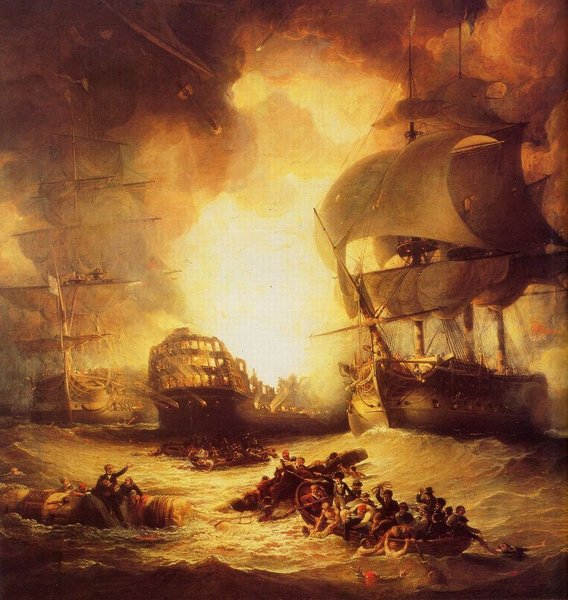
Casabianca is a powerful tale of a boy’s loyalty, obedience, and courage to stay upon a burning ship’s deck as the flames surround him while tearing down the ships structure. The images that are most prominent in this poem are that of the boy standing on the ship’s deck while the flames creep closer and surround him. The images of the boy on the deck reoccur throughout the entire poem subtly changing. In the beginning the poem creates a scene of the flames starting around the edges the ship, all the while the boy standing on the deck displaying his loyalty to his father. As the poem progresses the boy shouts to his father asking him for orders, and each time he asked in the poem the flames "roll'd on" and "made way" which evokes the image of the fire closing in on the boy’s location. In line 30 the flames caught the ships flag on fire, which showed the reader that the flames had spread to all areas of the ship. Although the boy stayed in the same spot throughout the poem the images that were described of him changed as well.
Casabianca is a powerful tale of a boy’s loyalty, obedience, and courage to stay upon a burning ship’s deck as the flames surround him while tearing down the ships structure. The images that are most prominent in this poem are that of the boy standing on the ship’s deck while the flames creep closer and surround him. The images of the boy on the deck reoccur throughout the entire poem subtly changing. In the beginning the poem creates a scene of the flames starting around the edges the ship, all the while the boy standing on the deck displaying his loyalty to his father. As the poem progresses the boy shouts to his father asking him for orders, and each time he asked in the poem the flames "roll'd on" and "made way" which evokes the image of the fire closing in on the boy’s location. In line 30 the flames caught the ships flag on fire, which showed the reader that the flames had spread to all areas of the ship. Although the boy stayed in the same spot throughout the poem the images that were described of him changed as well.
In the beginning he was just a boy who stood on the deck waiting for his orders from his father, by the second stanza he was a “proud, childlike form”, this paints a picture in the reader’s mind of person who is more than meets the eye. Although he is in a child’s body he has more inside of him than those crew members who fled the ship. In line 31 he is described as a “gallant child”, loyal to his father and the ship, and by line 40 he is “young faithful heart”. The young faithful heart further proves that the boy was courageous and faithful to his father’s word. The images of the boy are more prominent than of the flames. The boy was the main figure of all the images he was the center, the flames surrounded him. It seemed like the flames were a backdrop for the boy, who was the central figure of the poem. This poem presented the reader with plenty of picturesque scenes that displayed the boy’s strength and desire to obey his father’s orders.
Casabianca gave me an impression that the poems significance was to display the boy’s loyalty to his father by staying on the ship’s deck while the flames surrounded him. My interpretation of the poem was that the boy must have respected and had a special relationship with his father to have stayed behind on the burning ship to allow the flames to engulf him. Casabianca displays his “young faithful heart” by standing on the deck with his “heroic blood” pumping through his veins while the flames of death and battle surround him. This poem further proves that the strong, proud, and loyal do not have to be fully grown people, or young adults, it can be anybody, even a boy who was “born to rule the storm”.

No comments:
Post a Comment